
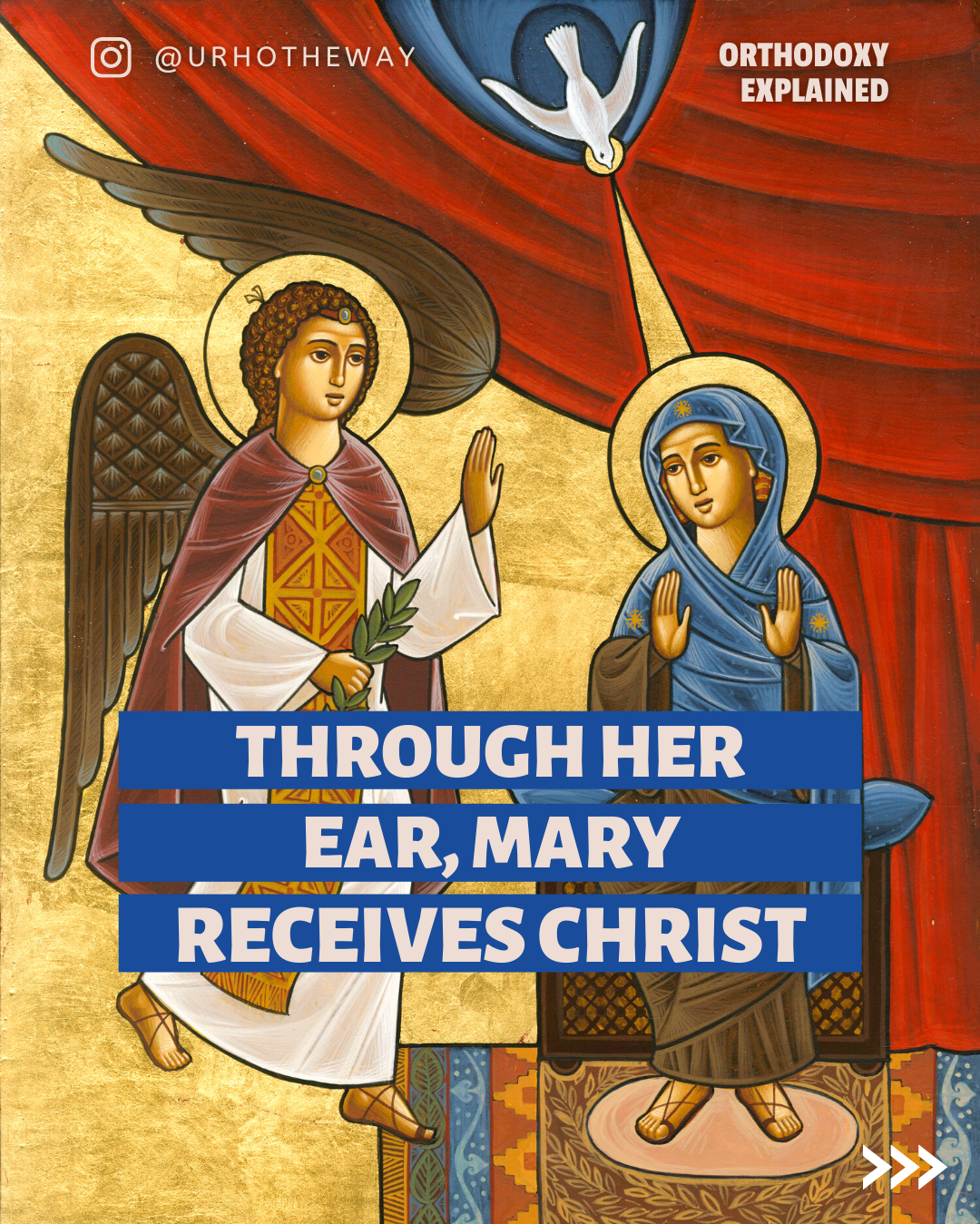
The Annunciation to St. Mary, the pivotal moment of our salvation history when the Archangel Gabriel announces the birth of Jesus by Mary, has been a favorite subject of religious art and iconography throughout the centuries.
Today, we will focus on one curious element present in many examples of such art – depicting the idea that “Christ was conceived through the ear of St. Mary”.
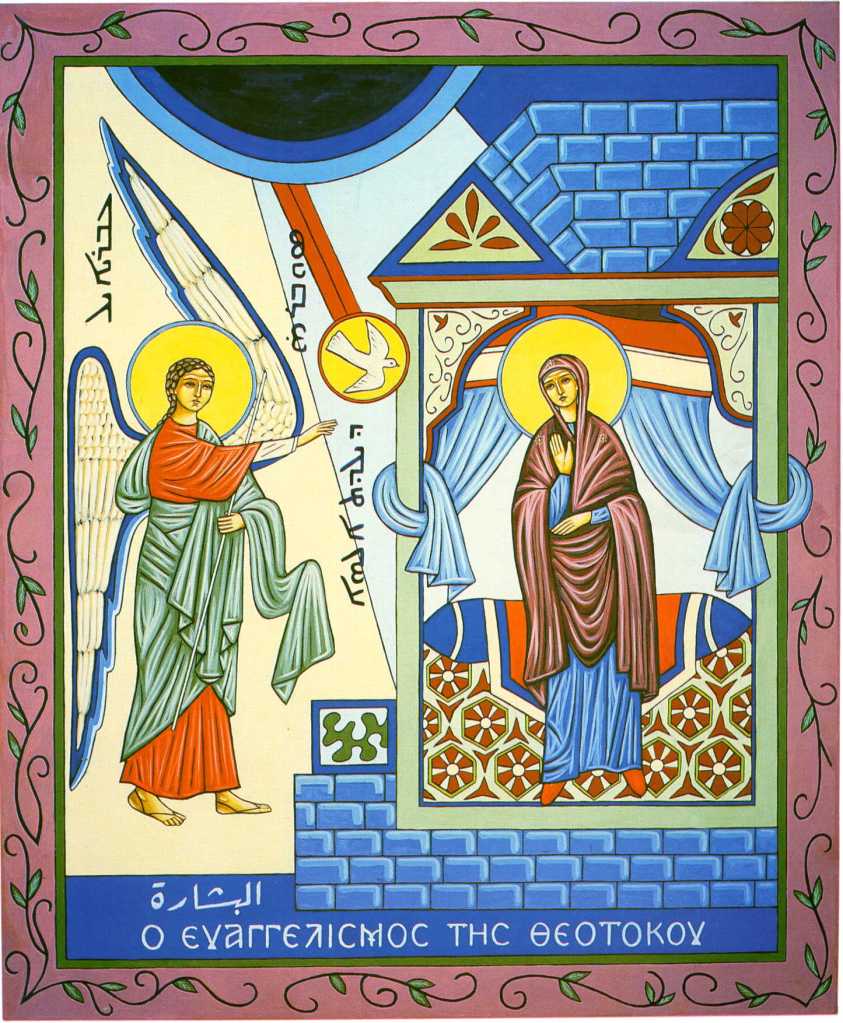
Analyzing an Icon of the Annunciation
In many paintings and icons of the Annunciation, like the one above, we see a dove, indicating the Holy Spirit, flying not towards St. Mary’s womb, but towards her ear.
This detail symbolizes that St. Mary did not conceive our Lord through her womb, but by “inclining her ear (cf. Psalm 45:10)” in attention to the words of God. We can find the basis for this symbolism in the writings of the Saints and the prayers of the Church.
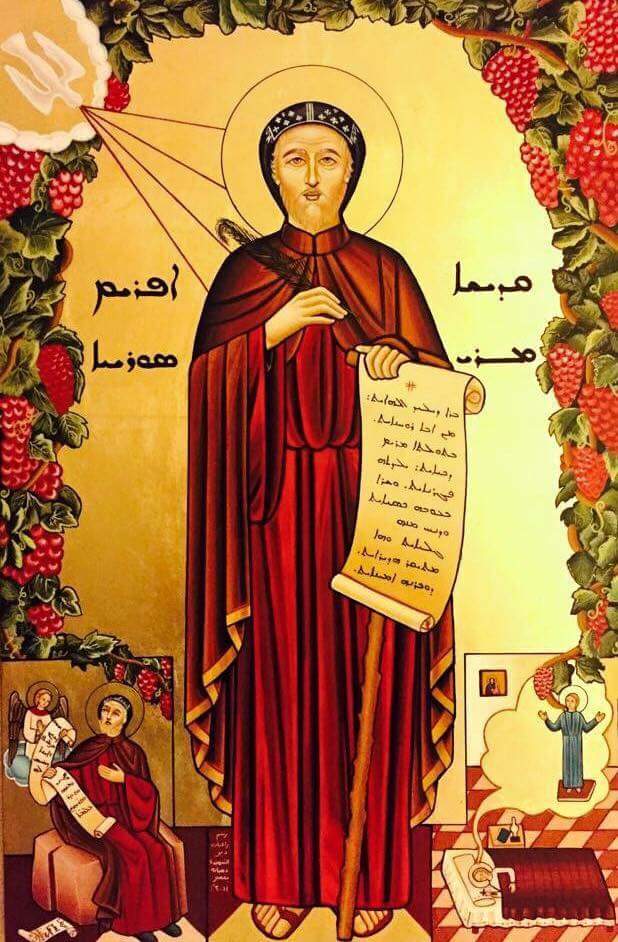
Theological Poetry: St. Ephrem the Syrian
The image of the ear being the mode of St. Mary’s conception is a popular one in the Syriac Christian tradition. Below, we have a few examples of this idea from St. Ephrem the Syrian (+AD 373). Often, he uses this image to create a contrast between Mary and Eve.
By means of the serpent the Evil One
poured out his poison in the ear of Eve
The Good One brought low His mercy
and entered through Mary’s ear
Through the gate by which death entered,
Life also entered, putting death to death.[1]
Just as the bush on Horeb bore
God in the flame
so did Mary bear
Christ in her virginity.
Perfectly God,
He entered the womb through her ear,
in all purity the God-Man
came forth from the womb into creation.[2]
He entered by the ear and
resided in the womb in hidden fashion;
He then left the womb
without undoing her virginity’s seal.
Likewise too when He left the tomb
He did so without undoing its seal.[3]
The Word of the Father made His descent down
to the ear by which misfortune had entered in:
He had watched the serpent’s tracks, and following up its traces,
washed away the dragon’s poison
from the ear of the chaste Virgin by His hovering descent.
For the snake’s insinuation which had wrought destruction
had entered in by the ear;
thus by the gate through which death had come, Life should enter in,
and there, in the very place of the sin,
grace, which has come to reign, should abound.[4]
Through Mary’s ear did the road travel by which Life entered in,
destroying the serpent’s footprints;
It shone out with the teaching of truth
and all that had been corrupted of old was restored.[5]
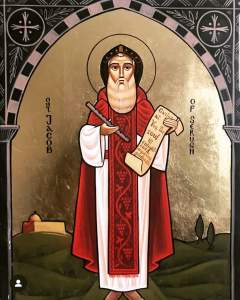
Theological Poetry: St. Jacob of Serugh
Arising from the same early Syriac tradition as St. Ephrem, we see St. Jacob of Serugh (+AD 521) making a similar comparison between Eve and Mary, again using the image of the ear as the mode of conception.
See how Eve’s ear inclines and hearkens
to the voice of the deceiver when he hisses deceit to her.
But come and see the Watcher instilling salvation into Mary’s ear
and removing the insinuation of the serpent from her and consoling her.
That building which the serpent pulled down, Gabriel built up;
Mary rebuilt the foundation which Eve broke down in Eden.
…
A virgin was beguiled by the mischief maker in Eden;
her ear piped the sound of the great deception.
Instead of this virgin another was chosen;
truth was spoken to her in her ear from the Most High.
By the door which death entered, by it entered life
and loosened the great bond which the evil one had bound there.[6]
Glory to the Son of God, who was pleased to come forth from the Blessed Holy Virgin; by her ear she received Him and she bore Him in her womb; He came forth from her womb and it remained sealed and confounded the unbelievers.[7]
Wednesday Evening Prayers of the Syriac Orthodox Church

Why This “Absurd” Concept?
We might be tempted to interpret “conception through the ear” literally, but this would be a mistake. St. Ephrem and St. Jacob do affirm the virgin birth, but they are not proposing scientific explanations. Rather, they are using this symbol to raise our minds from the physical to the spiritual.
“This quaint idea of Mary conceiving through her ear should be read typologically to be enlightened. Just as Eve hears the word of the serpent and conceives sin, so does Mary hear the word of God and conceive Christ. We conceive and embody what we give heed to.”[8]
Let us know in the comments if you learned something new!
Further Reading
- Macabasag, Nora Q. The Annunciation (Lk 1:26-38) In The Writings of Jacob of Serugh and Early Syriac Fathers. St. Ephrem Ecumenical Research Institute (SEERI), 2015, https://archive.org/details/annunciationlk120000nora.
- Puthuparambil, James. Mariological Thought of Mar Jacob of Serugh (451-521). St. Ephrem Ecumenical Research Institute (SEERI), 2005, https://archive.org/details/mariologicalthou0000jame.
- St. Ephrem. Bride of Light: Hymns on Mary From The Syriac Churches, translated by Sebastian P. Brock, SEERI, Kottayam, India, 1994, p. 57, https://archive.org/details/brideoflighthymn0000seba.
- St. Jacob of Serugh. On The Mother of God, translated by Mary Hansbury, St Vladimir’s Seminary Press, Crestwood N.Y., 1998, pp. 29-30, https://archive.org/details/onmotherofgod0000jaco.
- “Medieval Annunciation Symbolism.” Introducing Medieval Christianity, https://introducingmedievalchristianity.wordpress.com/2019/07/08/medieval-annunciation-symbolism/.
- Fr. Jonathan Lincoln. “Mary as the New Eve in St. Ephrem’s “Homily on the Nativity”.” Yearning for Paradise, https://yearningforparadise.wordpress.com/2018/02/10/mary-as-the-new-eve-in-st-ephrems-homily-on-the-nativity/.
- Weedman, Michelle, “Mary’s Fertility As The Model Of The Ascetical Life In Ephrem The Syrian’s Hymns Of The Nativity.”, 2014, http://epublications.marquette.edu/dissertations_mu/364
- Dorian Llywelyn SJ, “The Purple Thread, the Virgin’s Ear and the Book of the Annunciation.” Thinking Faith, https://www.thinkingfaith.org/articles/purple-thread-virgin%E2%80%99s-ear-and-book-annunciation
Endnotes
[1] St. Ephrem. “Homily on The Nativity.” The Harp of The Spirit: Eighteen Poems of Saint Ephrem, translated by Sebastian P. Brock, Fellowship of St. Alban and St. Sergius, UK, 1983, p. 66.
[2] St. Ephrem. “Homily on The Nativity.” The Harp of The Spirit: Eighteen Poems of Saint Ephrem, translated by Sebastian P. Brock, Fellowship of St. Alban and St. Sergius, UK, 1983, p. 62.
[3] St. Ephrem. “Hymns on Mary No. 11.” Bride of Light: Hymns on Mary From The Syriac Churches, translated by Sebastian P. Brock, SEERI, Kottayam, India, 1994, p. 57, https://archive.org/details/brideoflighthymn0000seba.
[4] St. Ephrem. “27: Hymns on Mary, second series No. 3.” Bride of Light: Hymns on Mary From The Syriac Churches, translated by Sebastian P. Brock, SEERI, Kottayam, India, 1994, p. 93.
[5] St. Ephrem. “28: Hymns on Mary No. 6.” Bride of Light: Hymns on Mary From The Syriac Churches, translated by Sebastian P. Brock, SEERI, Kottayam, India, 1994, p. 97.
[6] St. Jacob of Serugh. “1:627.” On The Mother of God, translated by Mary Hansbury, St Vladimir’s Seminary Press, Crestwood N.Y., 1998, pp. 29-30, https://archive.org/details/onmotherofgod0000jaco.
[7] “Ramsho on Wednesday.” Awsār Slawōt’o 1: The Book of Common Prayer, SEERI, Kottayam, India, 2006, p. 467, https://archive.org/details/awsarslawato1boo0000anon.
[8] Dayroyo Fr. Basil Paul. “Mary: The Divine Loom.” Urho, The Way, https://urhotheway.com/2020/08/14/mary-the-divine-loom/.
Subscribe to our mailing list to get all the latest posts and updates.
Follow us on our social media platforms to learn more about the love of God through our Syriac Orthodox faith.
You might also be interested in
 Urho, The Way