
Following the arrest of John the Baptist, Jesus withdrew to Galilee. Galilee was a Roman occupied territory with its own centres of power. Herod Antipas – a loyal patron to the Roman Emperors – was the Tetrarch of Galilee.
Herod Antipas demonstrated his fealty to the Imperial throne by building the city of Tiberias in honour of the Roman Emperor Tiberius and rebuilding as well as renaming the city of Sepphoris (renamed as Autocratoris – meaning “of the Emperor”) as a homage to Emperor Augustus. It was this same Herod who executed John the Baptist and presided over the inquisition of Jesus Christ in Galilee.
When Jesus withdrew to Galilee, He did not withdraw to imperial namesake cities like Tiberias and Sepphoris – the nucleus of imperial, political, economic, social and cultural powers – rather to Capernaum (ܟܦܰܪ ܢܰܚܽܘܡ which translates to ‘village of comfort’) located on the borders of Zebulun and Naphthali.
Galilee, as it is, was a marginal province (referred to as Galilee of the Gentiles v.15) and Capernaum within Galilee, a small agricultural and fishing village on the north-western shore of the Sea of Galilee was furthermore marginal.
Therefore, Jesus places himself with the marginalized. He identifies not with the rich but poor; not with the urban elite but the rural peasant; not with the rulers but the ruled, not with the powerful but the powerless and the exploited and finally with those who repulse the implementation of imperial vested interests on their lands and lives.
Secondly, the first words uttered by Jesus to the people in this Gospel are the exact words uttered by John the Baptist; “𝘙𝘦𝘱𝘦𝘯𝘵, 𝘧𝘰𝘳 𝘵𝘩𝘦 𝘬𝘪𝘯𝘨𝘥𝘰𝘮 𝘰𝘧 𝘩𝘦𝘢𝘷𝘦𝘯(𝘴) 𝘩𝘢𝘴 𝘤𝘰𝘮𝘦 𝘯𝘦𝘢𝘳” (4:17; 3:2). This bolsters the fact that John was truly the forerunner of Jesus. The Greek word employed for the phrase “come near/draw near” (ἤγγικεν) denotes immediate imminence suggesting that God’s Kingdom is displayed in the ministry of Jesus with continuing impact.
The phrase ‘Kingdom of Heaven(s)’ (βασιλεία τῶν οὐρανῶν) exclusively belongs to the Gospel of Matthew. All other gospels use Kingdom of God (βασιλεία τῶν Θεοῦ). This is because the Gospel of Matthew resolutely critiques earthly empires. Hence is justified the unique and the only occurrence of the phrase ‘gospel of the kingdom’ (εὐαγγέλιον τῆς βασιλείας – 24:14) in this Gospel. The evangelist introduces us to the Kingdom of Heaven(s) which is a kingdom of radical inclusion and inversion completely dissimilar to Roman Imperialism and Jewish racial fundamentalism.
Thirdly, born in Nazareth, beginning in Galilee and crucified on Golgotha, Jesus transforms the fringes into sites of theophany. Cicero was a Roman statesman and lawyer. According to Cicero’s ranking of occupations, the owners of agricultural lands adorned the first rank while fishermen were relegated to the last rank. Yet it was among these disenfranchised and the lowest of lows that the Kingdom of Heaven(s) was first manifested; for Jesus does not call qualified people or select qualified places rather He qualifies the people and places He chooses.
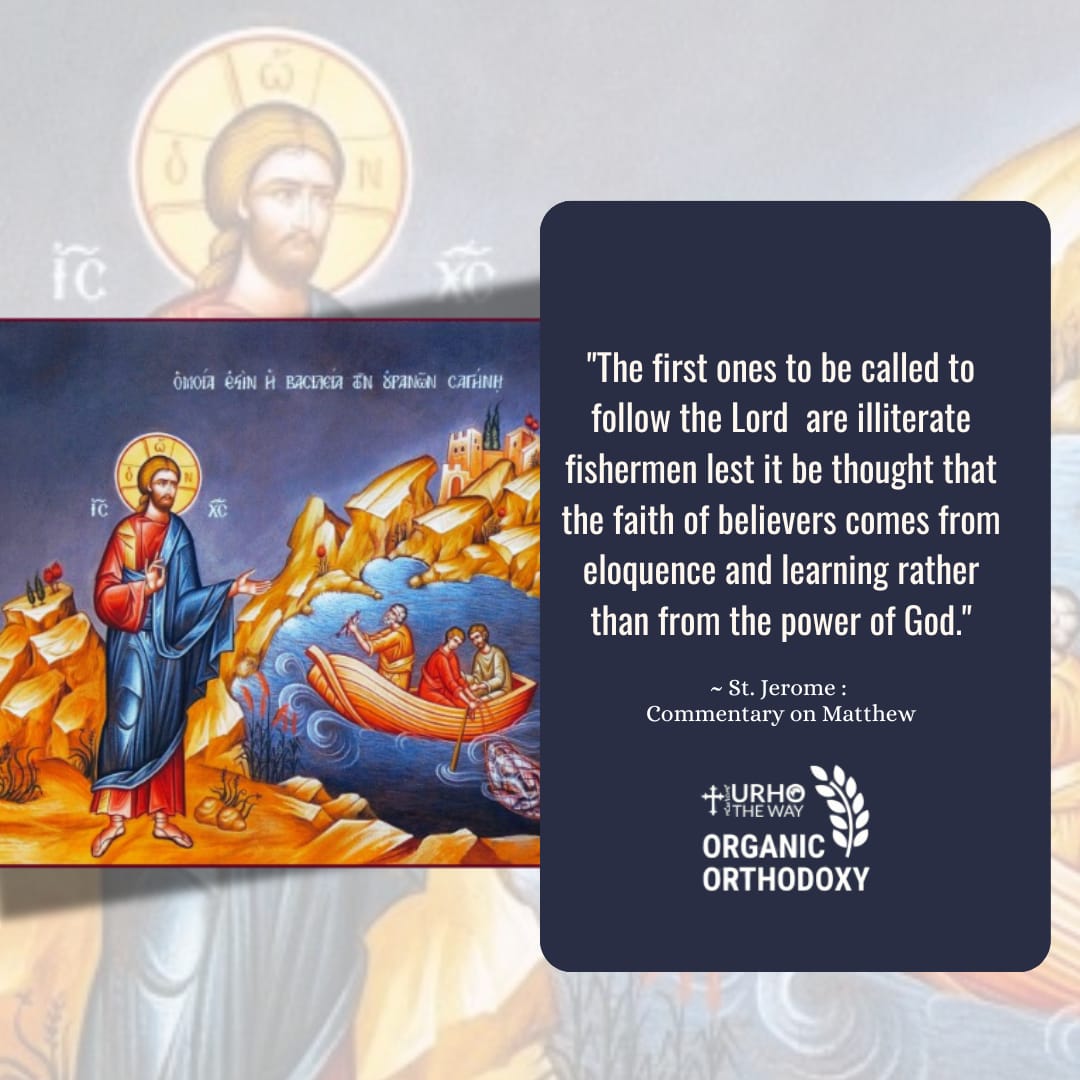
Thus St. Jerome remarked; “𝘛𝘩𝘦 𝘧𝘪𝘳𝘴𝘵 𝘰𝘯𝘦𝘴 𝘵𝘰 𝘣𝘦 𝘤𝘢𝘭𝘭𝘦𝘥 𝘵𝘰 𝘧𝘰𝘭𝘭𝘰𝘸 𝘵𝘩𝘦 𝘓𝘰𝘳𝘥 𝘢𝘳𝘦 𝘪𝘭𝘭𝘪𝘵𝘦𝘳𝘢𝘵𝘦 𝘧𝘪𝘴𝘩𝘦𝘳𝘮𝘦𝘯 𝘭𝘦𝘴𝘵 𝘪𝘵 𝘣𝘦 𝘵𝘩𝘰𝘶𝘨𝘩𝘵 𝘵𝘩𝘢𝘵 𝘵𝘩𝘦 𝘧𝘢𝘪𝘵𝘩 𝘰𝘧 𝘣𝘦𝘭𝘪𝘦𝘷𝘦𝘳𝘴 𝘤𝘰𝘮𝘦𝘴 𝘧𝘳𝘰𝘮 𝘦𝘭𝘰𝘲𝘶𝘦𝘯𝘤𝘦 𝘢𝘯𝘥 𝘭𝘦𝘢𝘳𝘯𝘪𝘯𝘨 𝘳𝘢𝘵𝘩𝘦𝘳 𝘵𝘩𝘢𝘯 𝘧𝘳𝘰𝘮 𝘵𝘩𝘦 𝘱𝘰𝘸𝘦𝘳 𝘰𝘧 𝘎𝘰𝘥.”
When Jesus calls his first four disciples viz. Simon, Andrew, James and John, His exhortation is very person-centric. He does not simply say “Follow my teachings” but very specifically “Follow me.”
A paradigm usually cited for Jesus calling His disciples is the calling of Elisha by Elijah. Yet what was Elisha’s immediate response to Elijah’s call? It was, “𝘓𝘦𝘵 𝘮𝘦 𝘬𝘪𝘴𝘴 𝘮𝘺 𝘧𝘢𝘵𝘩𝘦𝘳 𝘢𝘯𝘥 𝘮𝘺 𝘮𝘰𝘵𝘩𝘦𝘳 𝘢𝘯𝘥 𝘵𝘩𝘦𝘯 𝘐 𝘸𝘪𝘭𝘭 𝘧𝘰𝘭𝘭𝘰𝘸 𝘺𝘰𝘶.” (1 Kings 19:20).
To the contrary, Jesus’ call differs from the prophetic pattern. Jesus does not give time to bid adieu to one’s family. He demands an immediate response, as epitomized not only by the first four disciples – who immediately (εὐθέως) left their nets, boat and their father to follow Jesus (v 20, 22) – but even by Virgin Mary herself. Virgin Mary sought the consent of neither Joseph nor her parents before responding to the angel Gabriel; “𝘏𝘦𝘳𝘦 𝘢𝘮 𝘐, 𝘵𝘩𝘦 𝘴𝘦𝘳𝘷𝘢𝘯𝘵 𝘰𝘧 𝘵𝘩𝘦 𝘓𝘰𝘳𝘥; 𝘭𝘦𝘵 𝘪𝘵 𝘣𝘦 𝘸𝘪𝘵𝘩 𝘮𝘦 𝘢𝘤𝘤𝘰𝘳𝘥𝘪𝘯𝘨 𝘵𝘰 𝘺𝘰𝘶𝘳 𝘸𝘰𝘳𝘥.” (Lk 1:38).
The immediacy of the response to Jesus’ call is stressed elsewhere in this same Gospel i.e. 8:21-22; “𝘈𝘯𝘰𝘵𝘩𝘦𝘳 𝘰𝘧 𝘩𝘪𝘴 𝘥𝘪𝘴𝘤𝘪𝘱𝘭𝘦𝘴 𝘴𝘢𝘪𝘥 𝘵𝘰 𝘩𝘪𝘮, ‘𝘓𝘰𝘳𝘥, 𝘧𝘪𝘳𝘴𝘵 𝘭𝘦𝘵 𝘮𝘦 𝘨𝘰 𝘢𝘯𝘥 𝘣𝘶𝘳𝘺 𝘮𝘺 𝘧𝘢𝘵𝘩𝘦𝘳.’ 𝘉𝘶𝘵 𝘑𝘦𝘴𝘶𝘴 𝘴𝘢𝘪𝘥 𝘵𝘰 𝘩𝘪𝘮, ‘𝘍𝘰𝘭𝘭𝘰𝘸 𝘮𝘦 𝘢𝘯𝘥 𝘭𝘦𝘵 𝘵𝘩𝘦 𝘥𝘦𝘢𝘥 𝘣𝘶𝘳𝘺 𝘵𝘩𝘦𝘪𝘳 𝘰𝘸𝘯 𝘥𝘦𝘢𝘥.”
Jesus is not asking us to completely abandon our parents and kith and kin but to value Him above them. For we see Peter visiting his sick mother-in-law (8:14) as well as the mother of James and John making a request to Jesus on their behalf (20:20). Therefore, Jesus does not mandate a severance of relationships but most certainly a prioritization of Him over them.
~ 𝐃𝐚𝐲𝐫𝐨𝐲𝐨 𝐅𝐫. 𝐁𝐚𝐬𝐢𝐥
 Urho, The Way