
Dr. Simone Pratelli is a Scientific Assistant at the Research Center for Aramean Studies at the Department of History at the Goethe-University Frankfurt am Main, with his main research project being “A Critical Edition of the Syriac Universal Chronicle by Bar ‘Ebroyo with Its Continuations”.
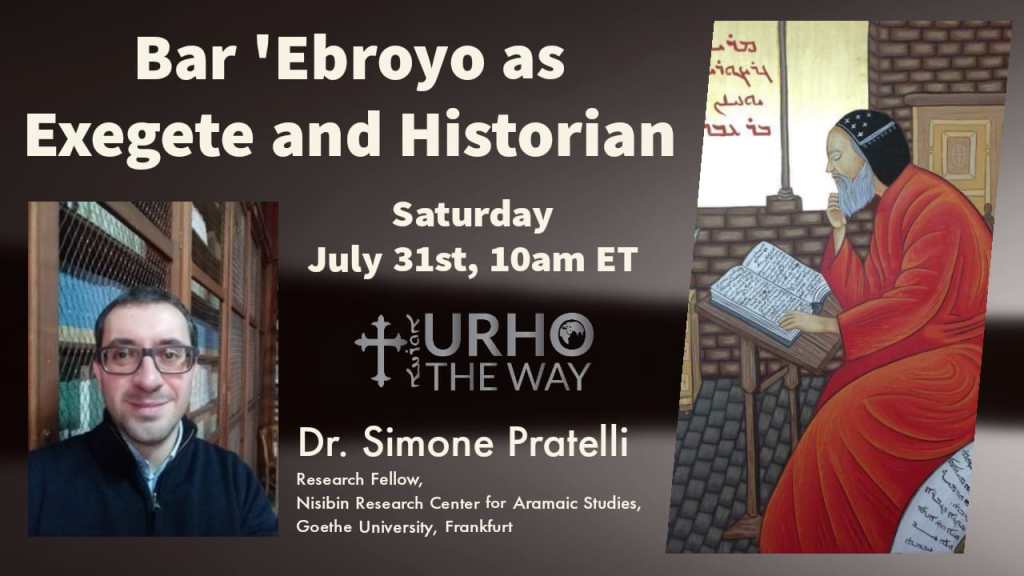
About Mor Gregorios Bar Ebroyo
Bar ʿEbroyo, Grigorios Grigorios (Abū al-Faraj, Barhebraeus) (1225/6–1286) was Maphryono since 1264 of the Syriac Orthodox Church and a philosopher, poet, grammarian, physician, biblical commentator, historian, and theologian. He was the foremost representative of the Syriac Renaissance of the 12th–13th cent. After periods of study in Antioch, Tripoli and Damascus, Bar ʿEbroyo was made bishop in 1246 of Gubos and a little later of Laqabin (both sees in the vicinity of Melitene) by Patriarch Ignatius III Dawid. In the schism that followed the death of Ignatius III, Bar ʿEbroyo was appointed in AD 1253 to the see of Aleppo, where he was to witness the fall of the city to the Mongols in 1260. The synod held in Cilicia following the death of Patriarch Yuḥanon bar Maʿdani in 1264 saw the double election of Ignatius IV Yeshuʿ (Patriarch, 1264–82) to the patriarchate and of Bar ʿEbroyo to the maphrianate.
Bar ʿEbroyo’s normal place of residence as maph. was Mosul and the nearby Dayro d-Mor Matay, but a significant part of his maphrianate was spent in Maragha and Tabriz, the new centers of power and learning under the Mongol Īl-Khāns, where Bar ʿEbroyo befriended the leading Muslim scholars of the day. During his maphrianate, Bar ʿEbroyo ordained a total of twelve bishops, including his biographer Diosqoros of Gozarto, and saw his erstwhile disciple Philoxenos Nemrod ( patr. 1283–92) elected to the patriarchate in 1283. He also entertained a friendly relationship with his Church of the East counterparts Denḥa I and Yahbalaha III. Bar ʿEbroyo died in Maragha on 29/30 July 1286. His remains were later transferred to Dayro d-Mor Matay, where they rest to this day together with those of his younger brother and successor in the maphrianate, Grigorios Barṣawmo Ṣafī.
Bar ʿEbroyo composed over forty works covering a wide range of subjects, mostly in Syriac, but occasionally also in Arabic. Taken as a whole, Bar ʿEbroyo’s literary output may be seen as an attempt at a revival of learning in Syriac through the use of the latest scholarly literature which was available in his day mostly in Arabic. Bar ʿEbroyo frequently modelled his works on works of Arabic and Persian authors (e.g., Ibn Sīnā, Ghazālī, Naṣīr al-Dīn al-Ṭūsī) and incorporated into the framework provided by these models materials taken from both Arabo-Persian and Syriac sources, thus making a new synthesis out of the older Syriac and more recent Arabo-Persian literature.
Bar ʿEbroyo has often been characterised as a skillful but unoriginal compiler of earlier works. This is a characterization that overlooks the originality to be found in his choice of sources and in his openness to the knowledge found in the works of Islamic scholars and those of other Christian denominations. His works were to remain for a long time the standard texts in many fields not only among the Christians of the West Syriac tradition but also among those of the East Syriac and Maronite traditions.
Subscribe to our mailing list to get all the latest posts and updates.
Follow us on our social media platforms to learn more about the love of God through our Syriac Orthodox faith.
 Urho, The Way