
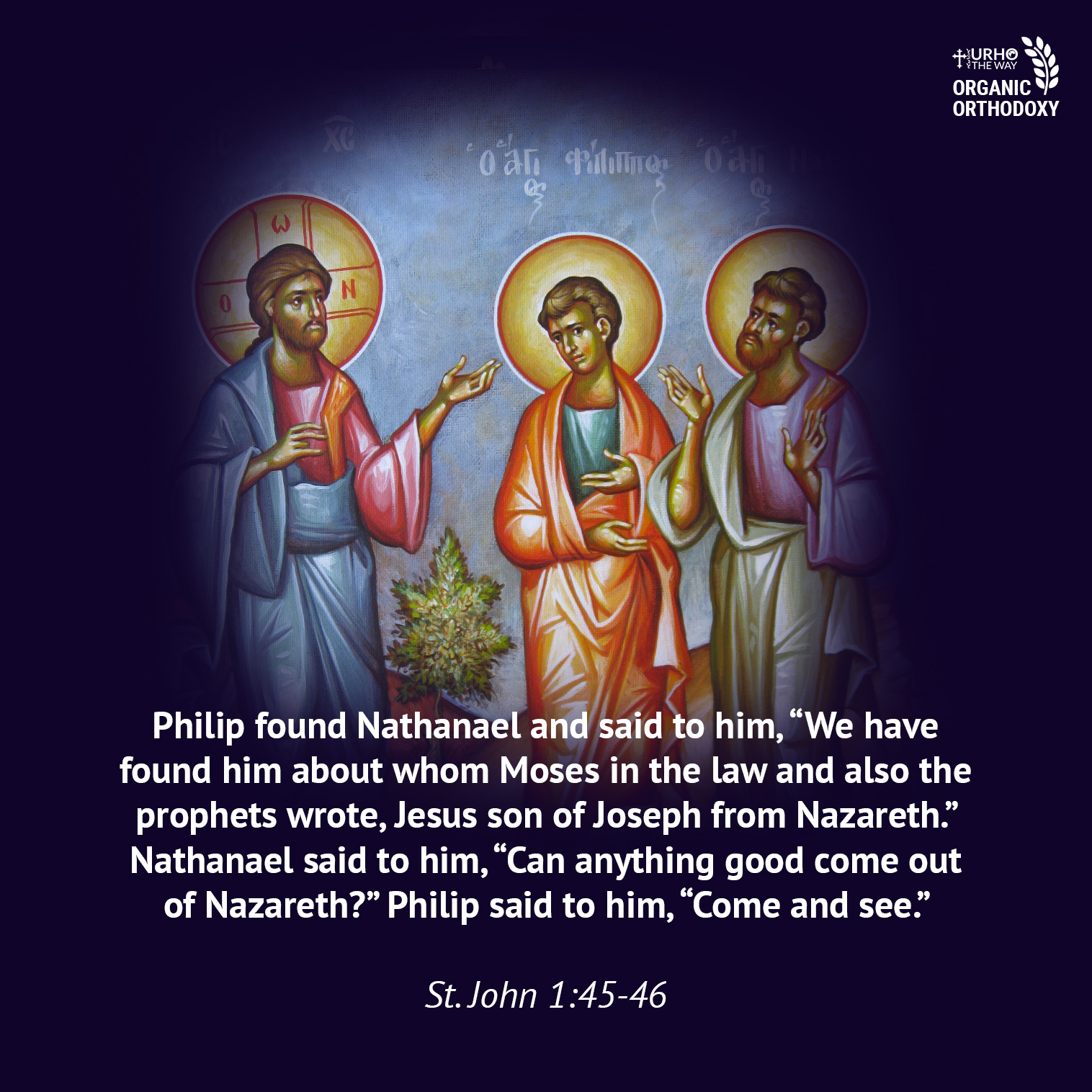
The Gospel of John bestows a great privilege on Philip. He becomes the first disciple to be personally called by Jesus. Andrew followed Christ eavesdropping the proclamation of John the Baptist – “Look here is the Lamb of God” (1:36). Andrew later led his brother Peter to Christ (1:42). Andrew, Peter and Philip were native of Bethsaida which means house of hunters or fishers. The name itself encapsulates their destiny i.e. to be fishers of people.
What is particularly interesting about the calling of Philip is that as soon as Christ calls him as an apostle, Philip begins to execute the responsibility of that office by going in search of Nathanael. This is what apostles were chosen for fundamentally; “He appointed twelve, whom he also named apostles, to be with Him, and to be sent out to proclaim the message.” (Mk.3:14).
The word apostle is derived from the Greek word ἀποστέλλω (apostello), meaning “to send forth.” In that sense Christ was the first apostle commissioned by the Father and hence Christ commissions His disciples likewise; “As the Father has sent me, so I send you.” (John 20:21). This is my personal favourite Great Commission passages among the five (Mt. 28:19; Mk.16:15; Lk. 24:49; John 20:21; Acts 1:8).
On the enthusiasm of Philip, St Cyril of Alexandria comments;
“The disciple is extremely quick to bear fruit so that he might be shown by this to have the same disposition as those before. He found Nathanael not by happening on him while Nathanael was walking but by searching diligently for him.”
Notice how Philip on meeting Nathanael introduces Christ; “We have found Him about whom Moses in the law and also the prophets wrote, Jesus son of Joseph from Nazareth.” (1:45). This introduction adumbrates the extensive Scriptural knowledge possessed by Philip. At the same time, it punctuates that Christ is the true and living Word of God. Scripture is only the word of God insofar as it points to Christ (John 5:39, 46; Lk. 24:47). We are therefore the followers of a living person rather than a frozen text.
Nathanael questions Philip; “Can anything good come out of Nazareth” (1:46). This question is completely justified for the Saviour was expected from Bethlehem and not Nazareth. Prophet Micah prophesied; “But you, O Bethlehem of Ephrathah, from you shall come forth one who is to rule in Israel whose origin is from of old, from ancient days.” (Mic: 5:2; John 7:41-42).
Galilee never gave rise to any prophets (7:52). However Christ grew up in Nazareth a town in Galilee (Lk. 4:16). By growing up in Nazareth, Christ transforms this place – usually considered the armpit of the society – into an epiphanic site capable of producing theological revelations. Not only that, He adopted Nazareth as a part of His name. This was the inscription placed over His Cross by Pontius Pilate – “Jesus of Nazareth, King of the Jews” (19:19). To this day we call Him Jesus of Nazareth and not Jesus of Bethlehem. God does not choose qualified places or people rather He qualifies the places and people whom He chooses.
It is remarkable how Philip quells the query of Nathanael; neither by rational discourses nor by futile wrangling rather by a simple and genuine invitation; “Come and see” (1:46). When we are similarly confronted with questions on our faith and practices we are expected to extend the same invitation; come to church and see for yourself. We are not meant to be saviours but to lead people to the Saviour. Philip was implicit that the words of Christ would captivate Nathanael as they did for others (Lk 4:22).
On seeing Nathanael approaching Him, Christ announces; “Here is truly an Israelite in whom there is no deceit.” (1:47). Nathanael is not flattered rather he enquires “Where did you know you get to know me?” (1:48). Nathanael here displays a version of boldness of speech which is exhibited by Mother of God and saints. In Syriac this is known as ܦܰܪܺܗܣܺܝܰܐ (Farisiyah). Bo’utho of Mor Jacob on Wednesday Vespers records;
“O daughter of David, you have great freedom to speak ܦܰܪܺܗܣܺܝܰܐ (Farisiyah) with that king who disposes of all kings. We beseech you, pearl without flaw, to intercede for us with the fruit that came forth from you.”
Jesus replies to Nathanael, “I saw you under the fig tree before Philip called you” (1:48). St. Augustine interprets this;
“Has this fig tree any meaning? We read of one fig tree which was cursed because it had only leaves and no fruit. Again, at the creation, Adam and Eve, after sinning, made themselves aprons of fig leaves. Fig leaves then signify sins; and Nathanael, when he was under the fig tree, was under the shadow of death.”
Thus Christ calls Nathanael when he was under the shadow of death. To this Nathanael confesses; “Rabbi, you are the Son of God! You are the King of Israel” (1:49). Partial as this confession of Nathanael may be – for Christ is not just the King of Israel rather He is the King of all nations – because of it all other disciples receive a boon. Christ said, “Very truly I tell you, you (ὄψεσθε – plural) will see heaven opened and the angels of God ascending and descending upon the Son of Man.” (1:51). Your friends matter. Good company yields great blessings.
~ Dayroyo Fr. Basil
 Urho, The Way